ABOUT THIS EVENT

Establishing A Cyber Safety Standard of Care for the Built Environment

A select gathering of academia, professional organizations, infrastructure owners, and the Nation’s leading companies providing engineering and cybersecurity services committed to protecting human safety in an automated society.


WHERE

National Academy of Sciences
2101 Constitution Ave NW, Washington, DC 20418

WHEN

Wednesday
June 10, 2026

Cyber Safety Summit DC - June 10, 2026
Cyber Safety Summit DC | June 10, 2026
A CALL TO ACTION

Emerging Global Need for a Cyber Safety Standard of Care

The rapid adoption of connected technologies across facilities and infrastructure is enhancing operational efficiency, user experience, sustainability, and security—spanning homes, buildings, transportation, healthcare, manufacturing, and consumer devices.

As information technology (IT) converges with operational technology (OT) to form cyber-physical systems (CPS), these integrated environments offer powerful new efficiencies and productivity. However, they also introduce novel risks and vulnerabilities, such as the overreliance of unsecured operational automation, which provides bad actors new disruption vectors with more exploitation pathways directly threatening public health, safety, and essential services.

Recent cyberattacks targeting our Nation’s critical infrastructure sectors – water systems, power grids, ports, pipelines, and transportation systems – have prompted multiple federal safety warnings.

These alerts underscore the urgent need for private sector owners and operators to invest in robust cyber protections that safeguard the public interest.

The global engineering and construction community must act now to establish formal Standards of Care for cyber safety to provide private sector owners with a set of foundational risk mitigation principles guiding the planning, design, construction, and operational phases of all future projects within the built environment.

The 2026 Cyber Safety Summit will convene subject matter experts and thought leaders to define what constitutes “reasonable knowledge, technical competence, and care” practiced within cybersecurity and control systems engineering.

Participants will break out into working groups to propose core requirements for internships, examinations, and admissions criteria that could form the basis for a future professional license in cyber safety design.

At the conclusion of the event, the CyberSafetySummit will formally present the consortium’s recommended standardized cyber safety elements relevant to networked, control systems engineering, and operational automation design to the NCEES Principles and Practice of Engineering Examination – Control Systems CBT Specifications for inclusionary consideration.

Additionally, selected technical papers will be presented to showcase engineering applications and best practices that enhance cyber safety within critical infrastructure and facility systems.

 

Event Sponsors

Event Partner

The Summit is seeking corporate sponsors to help ensure participants can attend the event at no cost. If you are interested in supporting this initiative through a donation or by sponsoring specific event costs, please email contact@cybersafetysummit.org.

Sponsorship opportunities include covering morning coffee, a catered lunch, and the evening reception. In appreciation of sponsorship support, your organization will receive formal recognition during each sponsored event. Explore our full range of sponsorship tiers and participation levels below to find the best fit for your organization.

Sponsorship Opportunities
At the Cyber Safety Summit

An inaugural Cyber Safety Summit 2026, taking place on June 10, 2026, at the National Academy of Sciences in Washington, D.C., is a national convening of infrastructure owners, insurers, engineers, designers, constructors, academia, and policymakers.

Together, we will establish the first-ever Cyber Safety Standard of Care for the built environment. In a world increasingly dependent on connected life-essential infrastructure—utilities, healthcare, transportation, water systems, buildings, homes —cyber risk can no longer be siloed.

Human safety depends on it.

The Summit is focused on turning intention into action by aligning technical standards, professional practice, and policy to protect life, health, and property.

Why Sponsor?

Sponsoring offers high-level visibility, direct engagement in a major national standards effort, a leadership role in advancing cyber-physical safety, and opportunities for ongoing collaboration and future initiatives.

Sponsorship Tiers
and Participation Levels

Pledge your support, today!

• Exclusive naming for event: “Summit to Establish Cyber Safety Standard in the Built Environment”

• Preferred/reserved seating for up to fifteen (5) company representatives at the Summit

• Public acknowledgement as sponsor throughout the event, with logo inclusion/recognition all signage, program materials, digital displays, event communication and marketing, and NAC and event websites

• Preferred/reserved seating for up to 5 company representatives at the Summit

• Public acknowledgement as sponsor throughout the event, with logo inclusion/recognition all
signage, program materials, digital displays, event communication and marketing, and NAC and
event websites

• Preferred/reserved seating for up to 5 company representatives at the Keynote Speaker session and
five Panel Discussions

• Public acknowledgement as Platinum Sponsor through logo inclusion all signage, program materials, digital displays, event communication and marketing, and NAC and event websites

• Preferred/reserved seating for up to 3 company representatives at the Keynote Speaker session and five Panel Discussions

• Public acknowledgement as Gold Sponsor through logo inclusion on all signage, program materials, digital displays, event communication and marketing, and NAC and event websites

• Preferred/reserved seating for up to 2 company representatives at the Keynote Speaker session and five Panel Discussions

• Public acknowledgement as Silver Sponsor through logo inclusion on all signage, program materials, digital displays, event communication and marketing, and NAC and event websites

• Preferred/reserved seating for up to 2 company representatives at the Keynote Speaker session and five Panel Discussions

• Public acknowledgement through logo inclusion on all signage, program materials, digital displays, event communication and marketing, and NJIT and event websites, as well as in the event app

• Preferred/reserved seating for one (1) company representatives at the Keynote Speaker session and five Panel Discussions

• Public acknowledgement as Panel Discussion Sponsor through logo inclusion on all signage, program materials, digital displays, and NAC and event websites

• Recognition as Summit Partner

• Lanyards with company logo

To discuss sponsorship opportunities and engagement, please reach out to the organizing committee.

Summit Agenda

Join a day of collaboration on cyber safety standards for the engineering, construction and facility management professionals.

June 10, 2026

8:00am-8:30am

Welcome by the National Academy of Construction, United Engineering Foundation, National Academy of Engineering – Recognition of Sponsors

8:30am-9:00am

National Threat Intelligence Presentation by CISA on Cyber Vulnerabilities in the Built Environment

9:00am-10:00am

Asset owners assume that the projects they commission from the engineering and construction industry will be safe for human interaction. Global engineering degree curriculums, professional licensing administered by States, and annual professional education requirements are intended for a project’s designers of record to incorporate standards of care, building codes, and industry best practices for human safety. Should owners be adequately informed of the expanding cyber threats that threaten human safety in their assets. Or should that awareness be an engineering responsibility? We’ll share the experience and expertise of professional engineers who are practicing cyber security engineering today.

Question and answer period to follow – Stay tuned for final panelist announcements

10:00am-10:15am

Networking Break

10:15am-11:00am

The relationship between insurance and professional engineering standards of care is highlighted usually when major engineering failures (fires, bridge collapse, boiler explosions) lead to significant loss of lives/property and resulting liability issues. Professional engineering societies have developed codes of ethics and practice standards in part to address public safety failures and insurance market concerns. Engineering firms want professional liability insurance while insurers require predictable professional behavior, defensible norms of practice, and evidence that engineers adhered to accepted standards of care. How can insurance and engineering standards organizations come together to identify the norms of practice for the safe design and construction of automated systems to mitigate the risk to life and property?

Question and answer period to follow – Stay tuned for final panelist announcements

11:00am-12:00pm

As the built environment is increasingly engineered with new digital technologies to connect systems for improved effectiveness, automation, and efficiencies, so should the engineering of protections from the cyber exploitation be included to enhance human safety. A Standard of Care and professional development requirement for cyber security engineering must include updated expertise in the range of new processes, techniques, and applications being developed by industry leaders committed to reducing cyber risks for operational technologies. This panel will discuss how commercial innovation can be incorporated into curriculums and professional education for engineers designing, specifying, constructing, and managing the life-cycle of a built system. 

Question and answer period to follow – Stay tuned for final panelist announcements

12:00pm-1:00pm

Lunch sponsored by Michael Baker Intl

1:00pm-1:45pm

Cyber-Informed Engineering (CIE) integrates cybersecurity considerations into the conception, design, development, and operation of any physical system to mitigate avenues for cyber-enabled attacks. Design decisions and engineering controls are prioritized to defend against the worst possible consequences of cyberattacks threatening human safety. How can we accelerate the implementation of CIE by establishing within the consequence management framework a subset of controls and protections that must be included by engineers to meet a standard for safe operation of the asset?

Question and answer period to follow – Stay tuned for final panelist announcements

1:45pm-2:45pm

Asset owners and industry practices are increasingly incorporating innovative technologies stacks, automated processes, and autonomous devices in the engineering of the built environment from buildings and infrastructure to transportation, healthcare, and robotics. The engineering responsibilities for the safe and secure design of these connected systems to preclude cyber exploitation has traditionally rested within the traditional disciplines. As technology stacks become more sophisticated, including connected technologies introduced by owners, the traditional disciplines can be overwhelmed. We’ll discuss the development of a cyber safety engineering curriculum, the requirements for professional licensure, and how the engineering profession can benefit from establishing a cyber safety engineer as a recognized designer of record. We’ll also discuss the existing training programs already established for professional development credits over a cyber safety engineer’s career.

Question and answer period to follow – Stay tuned for final panelist announcements

2:45pm-3:00pm

Networking Break

3:00pm-3:30pm

Academic White Paper Presentation
(as selected by executive committee)

3:30pm-4:00pm

Academic White Paper Presentation
(as selected by executive committee)

4:00pm-5:00pm

Break-out sessions for facilitated action group formation

  1. Developing standards for Reasonable Care in Cyber Safety
  2. Proposing requirements for a professional license to practice Cyber Safety
  3. Proposing engineering applications and best practices to enhance cyber safety in engineering and construction.

5:00pm-6:00pm

Town Hall, Wrap Up, and Next Actions

Register!

We invite you to register for the Cyber Safety Summit. Space is limited, so make sure to register today!

The event is currently planned as an in-person experience, with possible live streaming updates to be announced closer to the date.

Mission

Join a day of collaboration on cyber safety standards for engineering, construction and facility management professionals.

  • 1

    The A/E/C industry across all infrastructure sectors incorporate cyber safety practices into their body of knowledge, including engineering minimum requirements and specifications, for infrastructure systems that incorporate digital controls.

  • 2

    Engineers and technicians fully evaluate the potential for disruption and harm from cyber -attacks when designing and integrating digital components into systems.

  • 3

    Control systems are chosen and integrated into physical systems only when an assessment of human safety risks has been completed, and the organization accepts any residual risk after being accurately informed of potential consequences.

  • 4

    Effective and continuing communication is established among owners, operators, designers, maintainers, device manufacturers, and system integrators to support risk-informed decisions concerning the use of control systems in critical infrastructure during the design and construction phase.

  • 5

    Future automation and connected technologies are designed and certified to be cyber resilient.

  • 6

    Cyber risk management early in the system lifecycle results in a more effective and efficient application of cybersecurity controls during design and construction, and enabling resilient operation of critical functions over the life cycle of a facility or system.

  • 7

    The broad range of stakeholders responsible for critical infrastructure are appropriately informed about cyber risks and have a culture of accountability for cyber safety.

  • 8

    Engineered systems are more cost-effective to operate securely over their life cycle, and security controls are more effective because they were built in at the design phase.

Call for Papers

Interested parties are invited to submit technical papers for review by the Cyber Safety Summit Executive Board by January 15, 2026. on the following subjects. 3 papers will be selected for 30 minute in-person presentations on the afternoon of the Summit.

  • Defining Cyber Safety in the built environment
  • Developing standards for the reasonable care in Cyber Safety
  • Proposing requirements for a professional license to practice Cyber Safet
  • Recommending updates to engineering examinations
  • Proposing engineering applications and best practices to enhance cyber safety in engineering and construction

Please submit papers to the following email address:
contact@cybersafetysummitdc.org

Guidance for Papers

  • 1
    Please limit length to no more than 5 pages, excluding executive summary
  • 2
    Papers will be selected based on quality of contribution to one of the subject
  • 3

    Summit Organizers acknowledge the intellectual property of the authors – all papers will be protected from mass distribution unless otherwise agreed to by the author

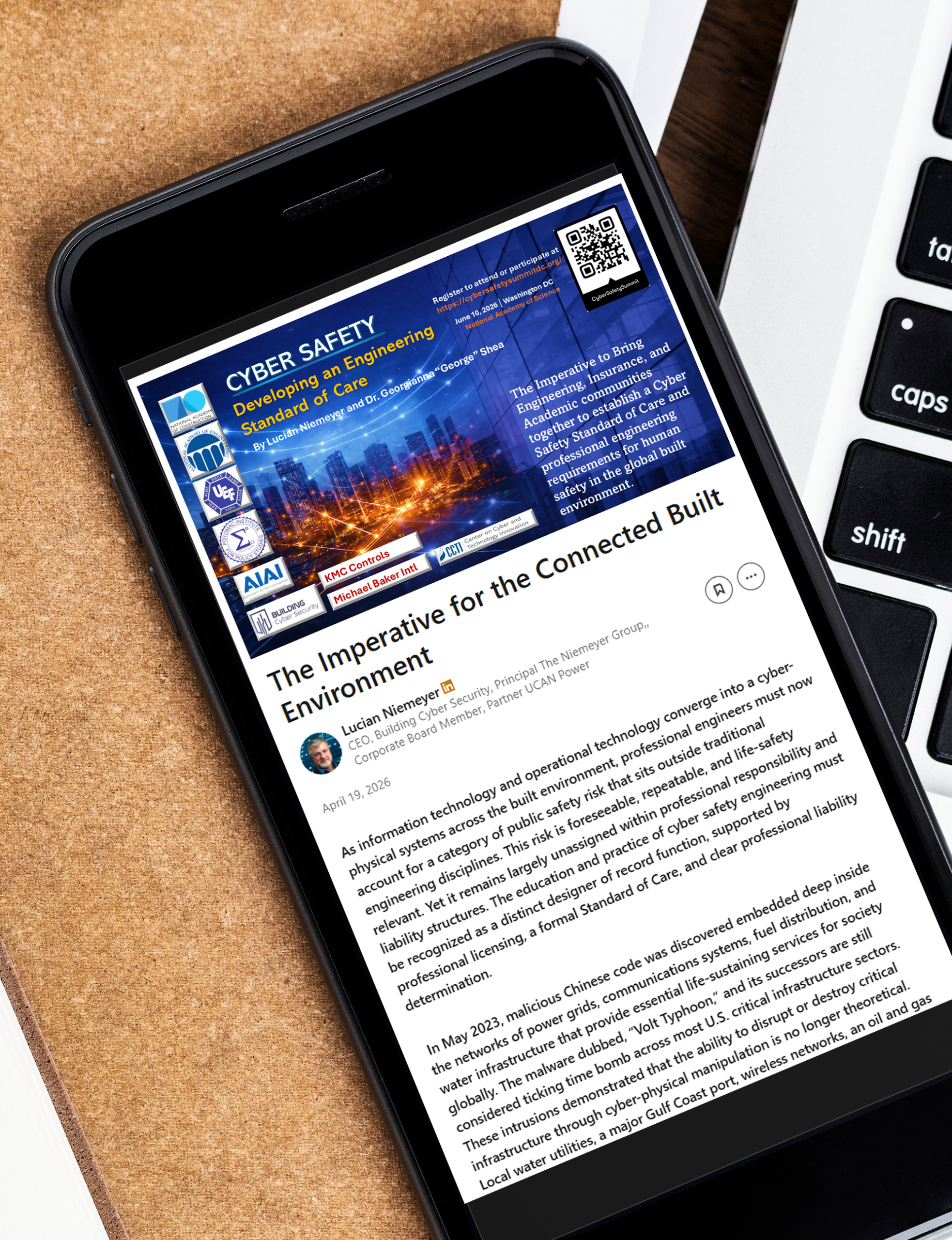
Article: The Imperative for the Connected Built Environment

As cyber and physical systems converge, a critical gap in engineering responsibility is putting real-world infrastructure—and public safety—at risk.

In The Imperative for the Connected Built Environment, Lucian Niemeyer and Dr. Georgianna Shea outline why cyber safety must be recognized as a core engineering function.